Software Development Company in Nepal
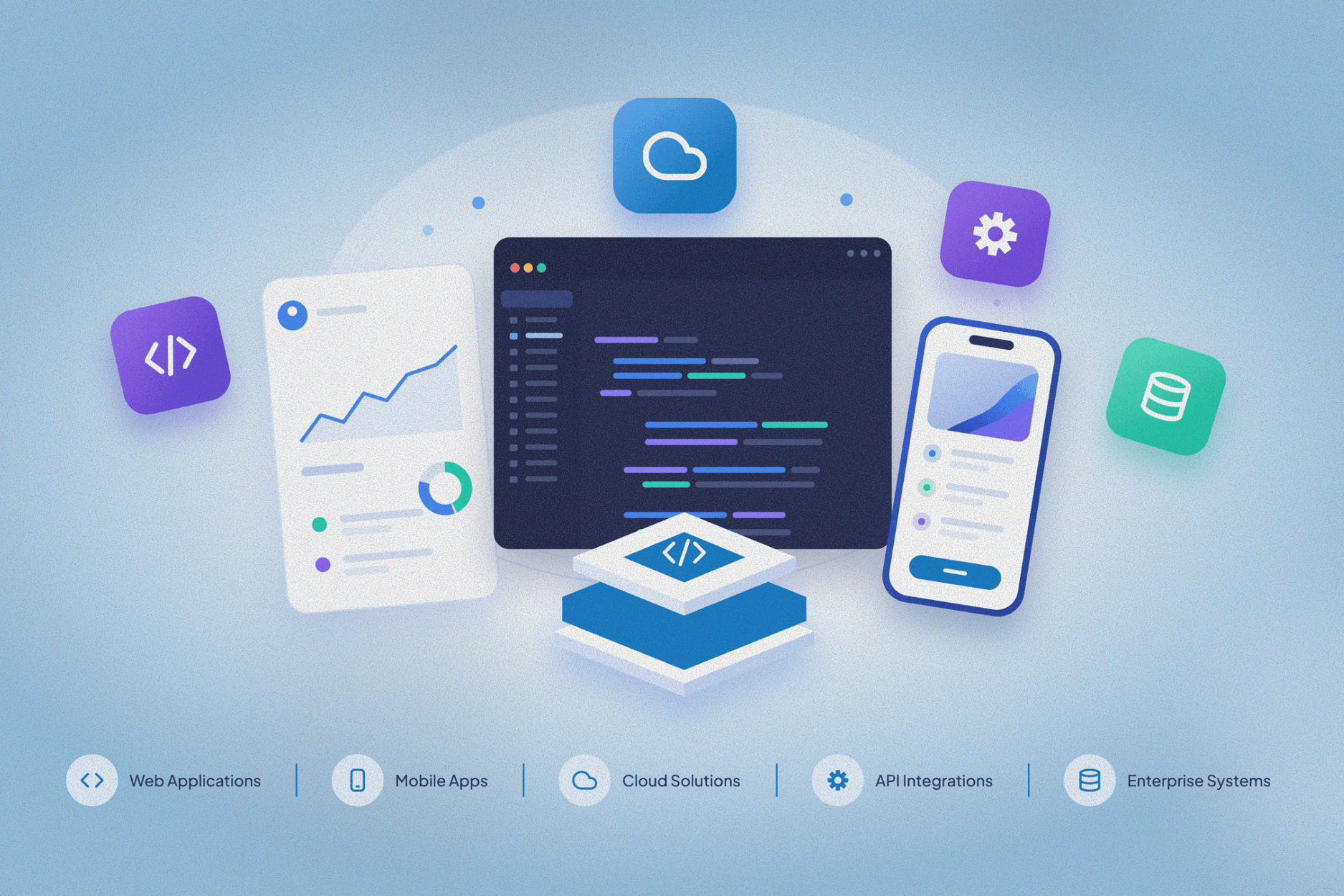
- Lumino Technology, based in Pokhara, Nepal, offers a wide range of software development services including custom software, web applications, mobile apps, and enterprise systems.
- The company provides tailored solutions for various industries, ensuring that software aligns with specific business needs and operational requirements.
- Businesses can benefit from cost-effective development, access to modern technologies, and long-term technical support when partnering with a software development company in Nepal.
Software Development Company in Nepal: Complete Guide to Every Type of Software Your Business Needs
Discover custom software development, web applications, mobile apps, enterprise systems, AI solutions, business automation, and digital transformation services with Lumino Technology.
Technology has become an essential part of how businesses operate, communicate, sell products, manage employees, serve customers, and compete in the global marketplace. Whether you are launching a startup, managing an established company, running a hospital, operating a hotel, building an online store, or managing an educational institution, the right software can help you work more efficiently and grow sustainably.
Nepal's technology industry is developing rapidly, with businesses increasingly adopting digital platforms, cloud applications, mobile technologies, automation, and custom-built software. Organizations are no longer looking only for websites. They need complete digital ecosystems that connect their operations, customers, employees, financial systems, and business data.
If you are searching for a reliable software development company in Nepal, Lumino Technology provides technology and digital solutions designed around real business requirements. Based in Pokhara, Nepal, Lumino Technology works with startups, small businesses, enterprises, organizations, and international clients to design, develop, deploy, and maintain digital products.
From simple business websites to complex enterprise management platforms, our goal is to help businesses turn ideas into practical, scalable, and sustainable technology solutions.
What Is a Software Development Company?
A software development company is a technology organization that plans, designs, develops, tests, deploys, and maintains software applications for individuals, businesses, institutions, and enterprises.
Software development involves much more than writing code. It begins with understanding a problem, identifying business requirements, designing an appropriate solution, selecting technologies, developing the application, testing its functionality, and providing ongoing technical support.
A professional software development company can help you build:
Websites and web applications.
Android and iOS mobile applications.
Custom business management software.
Enterprise Resource Planning (ERP) systems.
Customer Relationship Management (CRM) systems.
Human Resource Management Systems (HRMS).
Accounting and financial management software.
Inventory and warehouse management systems.
E-commerce and online marketplace platforms.
Hospital and healthcare management software.
School, college, and university management systems.
Hotel and restaurant management software.
Artificial Intelligence (AI) applications.
Cloud-based SaaS platforms.
Cybersecurity and data management solutions.
Automation and API integration systems.
The best solution depends on your organization's size, industry, budget, workflows, customers, and long-term objectives.
Why Choose a Software Development Company in Nepal?
Nepal is becoming an attractive destination for software development, IT outsourcing, technology consulting, and digital product development.
Businesses can work with Nepali development teams to create technology products for domestic and international markets.
1. Cost-Effective Software Development
Building software requires investment in planning, design, development, testing, infrastructure, and maintenance.
Working with a software development company in Nepal can provide access to skilled technology professionals and flexible development arrangements.
Instead of purchasing expensive software that does not match your operations, you can invest in a solution designed around your actual requirements.
2. Custom Solutions for Local and International Businesses
Different businesses have different operational requirements.
A hotel needs reservation and property management capabilities. A hospital needs patient records and appointment management. An e-commerce company needs product catalogs, payment integrations, and order management.
Custom software makes it possible to develop functionality that matches your business processes.
3. Access to Modern Technologies
Modern software development involves technologies such as:
React.js and Next.js.
Node.js and Express.js.
MongoDB and PostgreSQL.
Flutter and React Native.
Python and Django.
PHP and Laravel.
WordPress.
Cloud infrastructure.
Artificial Intelligence and machine learning.
APIs and third-party integrations.
The right technology stack depends on the application and its requirements.
4. Long-Term Technical Support
Software is not a one-time investment. It requires regular updates, security improvements, performance monitoring, bug fixes, and compatibility maintenance.
A long-term development partner can help your software evolve as your organization grows.
Complete Types of Software Development Services
Every organization has different software requirements. Below is a comprehensive guide to the major software categories businesses and individuals may need.
1. Custom Software Development
Custom software is designed and developed specifically for your business rather than forcing your organization to adapt to an existing generic application.
It is suitable for organizations with unique workflows, specialized requirements, or plans to build their own technology products.
Examples include:
Business management software.
Custom administration dashboards.
Workflow automation systems.
Internal employee portals.
Business intelligence platforms.
Document management systems.
Customer service applications.
Industry-specific management systems.
Multi-user business platforms.
Custom reporting applications.
Who needs custom software?
Startups, enterprises, government-related organizations, educational institutions, healthcare providers, financial businesses, and companies with specialized operational requirements.
2. Website Development and Web Application Development
A professional website is often the first interaction customers have with your business.
Website development involves creating responsive, secure, accessible, and search-engine-friendly digital experiences.
Types of websites businesses need
Business and corporate websites: Professional websites presenting company information, services, products, contact details, and business credentials.
E-commerce websites: Online stores that allow customers to browse products, place orders, make payments, and track deliveries.
Portfolio websites: Websites for professionals, designers, developers, photographers, agencies, and creative businesses.
News and media websites: Publishing platforms for newspapers, magazines, online news portals, and digital media organizations.
Educational websites: Websites for schools, colleges, universities, training centers, and online learning providers.
Hotel and tourism websites: Websites featuring accommodation, travel packages, booking inquiries, destinations, and tourism services.
Restaurant websites: Digital platforms displaying menus, reservations, restaurant information, delivery options, and customer experiences.
Real estate websites: Property listing platforms with search filters, property information, inquiries, and management dashboards.
Membership websites: Platforms offering exclusive content, subscriptions, user accounts, and member services.
Landing pages: Conversion-focused pages for marketing campaigns, lead generation, and product launches.
Advanced web applications
Beyond traditional websites, businesses may require sophisticated browser-based applications, including:
Customer portals.
Vendor portals.
Employee dashboards.
Online booking systems.
Multi-vendor marketplaces.
Project management platforms.
Learning management systems.
SaaS applications.
Online collaboration tools.
Enterprise dashboards.
Lumino Technology develops modern web experiences and application platforms using suitable technologies such as Next.js, React, Node.js, WordPress, and database technologies.
3. Mobile Application Development
Mobile applications allow businesses to connect with customers through smartphones and tablets.
A mobile application can improve accessibility, customer engagement, communication, and operational efficiency.
Android app development
Android applications serve users across a wide range of smartphone manufacturers and devices.
Common Android application types include:
Shopping applications.
Food delivery applications.
Taxi and ride-booking applications.
Education and learning applications.
Healthcare applications.
Banking and payment applications.
News and media applications.
Business management applications.
Social networking applications.
Travel and tourism applications.
iOS app development
iOS applications are designed for Apple's iPhone and iPad ecosystem.
Businesses targeting premium mobile experiences or customers using Apple devices may benefit from dedicated iOS development.
Cross-platform app development
Cross-platform technologies such as Flutter and React Native allow development teams to build applications for multiple mobile platforms using shared codebases where appropriate.
Progressive Web Applications (PWA)
PWAs combine website accessibility with selected app-like capabilities. They can provide installable experiences, offline functionality where supported, and responsive mobile interfaces.
4. Enterprise Resource Planning (ERP) Software
ERP software connects different departments and business operations through an integrated management platform.
Instead of maintaining separate systems for accounting, purchasing, inventory, human resources, and sales, an ERP system brings essential information together.
Important ERP modules
Financial management.
Accounting management.
Human resource management.
Inventory management.
Procurement management.
Sales management.
Purchase management.
Warehouse management.
Manufacturing management.
Supply chain management.
Project management.
Customer management.
Reporting and analytics.
Who needs ERP software?
Manufacturing companies, distributors, wholesalers, retailers, educational institutions, hospitality groups, and growing enterprises.
ERP systems can improve operational visibility, reduce duplicate data entry, and support better business decisions.
5. Customer Relationship Management (CRM) Software
CRM software helps businesses manage customer information, sales activities, communication, and relationships.
A CRM platform provides a structured way to organize leads and monitor the customer journey.
CRM features
Customer database management.
Lead generation and tracking.
Sales pipeline management.
Contact management.
Customer communication history.
Follow-up reminders.
Marketing campaign integration.
Sales performance reporting.
Customer support management.
Automated notifications.
Types of CRM software
Operational CRM: Manages sales, marketing, and customer service workflows.
Analytical CRM: Helps analyze customer data and business performance.
Collaborative CRM: Supports communication and information sharing between teams.
Industry-specific CRM: Provides specialized functionality for real estate, hospitality, healthcare, education, financial services, and other sectors.
6. Human Resource Management System (HRMS) and HR Software
Managing employees manually can become difficult as organizations grow.
HR software helps businesses organize employee information, attendance, payroll, recruitment, leave, and workforce administration.
Common HRMS features
Employee database.
Employee onboarding.
Attendance management.
Biometric attendance integration.
Leave management.
Payroll processing.
Salary calculations.
Tax and deduction management.
Shift scheduling.
Performance evaluation.
Recruitment management.
Employee self-service portals.
Department and designation management.
Role-based access control.
Additional HR solutions
Organizations may also require:
Recruitment Management Systems (RMS).
Applicant Tracking Systems (ATS).
Payroll Management Systems.
Workforce Management Software.
Employee Performance Management Software.
Learning and Development Management Systems.
Lumino Technology also develops HR-related digital products, including its HRM and payroll-oriented solutions.
7. Accounting and Financial Management Software
Accounting software helps businesses record financial transactions, monitor income and expenses, manage invoices, and prepare financial reports.
Accounting software features
General ledger.
Accounts payable.
Accounts receivable.
Invoice management.
Expense tracking.
Tax calculations.
Financial reporting.
Bank reconciliation.
Budget management.
Cash flow monitoring.
Multi-currency support.
Financial statements.
Other financial software
Billing and invoicing systems.
Point of Sale (POS) software.
Budget management platforms.
Loan management systems.
Cooperative management software.
Subscription billing systems.
Financial analytics dashboards.
For Nepali businesses, local tax requirements, VAT workflows, accounting practices, and relevant payment integrations should be considered during development.
8. Inventory and Warehouse Management Software
Inventory management software helps organizations monitor products, stock levels, purchases, sales, and warehouse operations.
Key features
Product catalog management.
Stock tracking.
Barcode and QR code scanning.
Purchase orders.
Supplier management.
Warehouse management.
Stock transfers.
Low-stock alerts.
Batch and expiry tracking.
Product variations.
Inventory valuation.
Sales integration.
Inventory reporting.
This software is especially useful for wholesalers, retailers, supermarkets, pharmacies, distributors, manufacturers, and e-commerce businesses.
9. E-commerce and Online Marketplace Software
E-commerce software allows businesses to sell products and services online.
Whether you want to create a small online store or a large marketplace, the platform should support secure transactions and efficient order management.
Types of e-commerce platforms
B2C (Business to Consumer): Businesses sell directly to individual customers.
B2B (Business to Business): Businesses sell products or services to other businesses.
C2C (Consumer to Consumer): Individuals trade with other individuals through a platform.
D2C (Direct to Consumer): Manufacturers and brands sell directly to customers.
Multi-vendor marketplace: Multiple sellers list products on a single platform.
E-commerce functionality
Product management.
Shopping cart.
Secure checkout.
Payment gateway integration.
Order management.
Customer accounts.
Shipping integration.
Discount and coupon management.
Inventory synchronization.
Product reviews.
Sales analytics.
Seller dashboards.
Returns and refunds management.
For the Nepali market, businesses may require integrations with payment services such as eSewa and Khalti, alongside appropriate international payment options where available.
10. Point of Sale (POS) Software
POS software helps businesses process sales and manage transactions at physical locations.
It is commonly used by restaurants, cafes, retail stores, supermarkets, hotels, and service providers.
POS functionality
Sales billing.
Product scanning.
Receipt generation.
Cash management.
Payment tracking.
Inventory synchronization.
Discount management.
Customer management.
Employee permissions.
Daily sales reports.
Multiple outlet management.
Offline operation where supported.
Advanced POS solutions can connect with accounting, inventory, CRM, and ERP platforms.
11. Hospital and Healthcare Management Software
Healthcare institutions need specialized software to manage patients, medical records, appointments, billing, and clinical operations.
Hospital Management System (HMS)
Common modules include:
Patient registration.
Appointment scheduling.
Doctor management.
Electronic Medical Records (EMR).
Electronic Health Records (EHR).
OPD and IPD management.
Laboratory management.
Pharmacy management.
Billing and payments.
Insurance administration.
Medical reporting.
Bed and ward management.
Other healthcare applications
Clinic management software.
Dental clinic management systems.
Pharmacy management software.
Diagnostic laboratory systems.
Telemedicine applications.
Patient appointment applications.
Healthcare mobile applications.
Medical inventory management.
Healthcare systems must be designed with strict access controls, privacy protections, security safeguards, and applicable legal requirements.
12. School, College and University Management Software
Educational institutions need digital systems to organize academic and administrative activities.
An Education Management System (EMS) can help schools, colleges, and universities manage information from admission to graduation.
Education software features
Student registration.
Admission management.
Attendance management.
Examination management.
Grade management.
Timetable scheduling.
Teacher management.
Fee management.
Parent communication.
Library management.
Academic reporting.
Online assignments.
Student portals.
Teacher portals.
Parent portals.
Learning Management System (LMS)
An LMS provides digital learning environments for online courses, training programs, and educational content.
Typical features include:
Online course creation.
Video lessons.
Learning materials.
Online examinations.
Assignment submission.
Student progress tracking.
Certificates.
Instructor dashboards.
Course subscriptions.
13. Hotel, Hospitality and Tourism Management Software
Nepal's hospitality and tourism industries have unique technology requirements.
Hotels, resorts, restaurants, travel agencies, and tour operators can use integrated software to manage daily operations.
Hotel Management System (PMS)
Reservation management.
Room availability.
Check-in and check-out.
Guest profiles.
Housekeeping.
Room billing.
Payment management.
Channel integrations.
Occupancy reports.
Restaurant Management Software
Digital menus.
Table reservations.
Order management.
Kitchen Display Systems (KDS).
POS integration.
Staff management.
Billing.
Delivery management.
Customer loyalty programs.
Travel and tourism software
Tour booking platforms.
Travel agency management.
Online reservation systems.
Tour package management.
Guide management.
Vehicle and transport management.
Customer inquiry management.
Travel itinerary management.
Payment tracking.
14. News Portal and Media Management Software
Digital media organizations need publishing platforms that support high volumes of content, multiple authors, editorial workflows, and audience growth.
A News Portal CMS allows publishers to manage online news operations from a centralized dashboard.
News CMS features
Article publishing.
Category management.
Journalist accounts.
Editorial approval workflows.
Image and video management.
Breaking news management.
Homepage management.
Advertisement management.
Social media integration.
SEO-friendly URLs.
XML sitemaps.
News sitemap support.
Structured data.
Analytics integration.
Multilingual publishing.
Other media software
Digital magazine platforms.
Online newspaper systems.
Radio station management.
Podcast publishing platforms.
Video content management systems.
Digital broadcasting platforms.
Media asset management systems.
Lumino Technology has experience with news publishing solutions, including its news portal CMS projects.
15. Artificial Intelligence (AI) Software and Automation
Artificial Intelligence is changing how organizations manage information, communicate with customers, and automate repetitive tasks.
AI-powered software can support employees, improve workflows, and provide intelligent assistance.
AI software solutions
AI customer support assistants.
AI-powered chatbots.
Document processing systems.
AI content assistance tools.
Intelligent search systems.
Recommendation engines.
Data analysis platforms.
Automated reporting systems.
Speech-to-text applications.
Text-to-speech applications.
AI-powered business assistants.
Knowledge management systems.
Machine Learning applications
Machine learning can be used for:
Predictive analytics.
Demand forecasting.
Fraud detection.
Customer behavior analysis.
Product recommendations.
Classification and recognition.
Operational forecasting.
Business process automation
Automation can reduce repetitive administrative work through workflow engines, APIs, notifications, integrations, and scheduled processes.
AI solutions should be selected according to business objectives, data availability, security, accuracy requirements, and operating costs.
16. Cloud-Based Software and SaaS Development
Software as a Service (SaaS) allows customers to access applications over the internet, often through subscription-based plans.
Instead of installing and maintaining software independently, users access a centrally managed platform.
SaaS application examples
Project management software.
CRM platforms.
HR management applications.
Accounting platforms.
Marketing automation systems.
Online booking applications.
Customer support systems.
Business analytics platforms.
Collaboration tools.
Subscription management systems.
SaaS development features
Multi-tenant architecture.
User authentication.
Subscription management.
Payment integration.
Role-based permissions.
Cloud hosting.
Data backup.
API integration.
Usage monitoring.
Scalable infrastructure.
SaaS products can help software entrepreneurs turn a business idea into a recurring-revenue technology product.
17. Project Management and Task Management Software
Organizations need effective systems to coordinate employees, deadlines, projects, and responsibilities.
Project management software provides centralized visibility into work progress.
Common features
Project creation.
Task assignment.
Team collaboration.
Deadline management.
Project timelines.
Kanban boards.
Gantt charts.
Document sharing.
Time tracking.
Progress reports.
Notifications.
Resource allocation.
It is suitable for software companies, construction organizations, marketing agencies, educational institutions, and distributed teams.
18. Document Management and Digital Record Software
Paper-based documentation can create challenges related to storage, searching, sharing, and security.
Document Management Systems (DMS) provide centralized digital document organization.
Features
Digital document storage.
File categorization.
Document search.
Version control.
User permissions.
Document approval workflows.
Electronic signatures where supported.
Audit trails.
Secure sharing.
Backup and recovery.
These systems are useful for corporate offices, law firms, educational institutions, healthcare providers, and government-related organizations.
19. Communication and Messaging Software
Businesses increasingly depend on digital communication systems to connect employees, customers, suppliers, and partners.
Communication software
Bulk SMS platforms.
OTP delivery systems.
Email management platforms.
Unified communication systems.
Live chat applications.
Customer support messaging.
Internal team messaging.
Notification management.
WhatsApp Business integrations.
Multi-channel communication platforms.
Lumino Technology also offers messaging-related products and solutions, including Lumino SMS for bulk messaging and OTP delivery.
20. Booking, Appointment and Reservation Software
Booking applications simplify the process of scheduling services and managing availability.
Booking software examples
Hotel booking systems.
Restaurant reservation systems.
Doctor appointment applications.
Salon booking platforms.
Spa appointment systems.
Vehicle rental software.
Event registration platforms.
Tour booking systems.
Consultation scheduling.
Online service reservation.
Important features
Real-time availability.
Online booking forms.
Calendar integration.
Customer accounts.
Booking confirmations.
Automated notifications.
Payment integration.
Cancellation management.
Staff scheduling.
Booking reports.
21. Real Estate and Property Management Software
Property businesses need digital tools to manage listings, clients, rental information, and transactions.
Common features
Property listing management.
Property search.
Location-based search.
Rental management.
Tenant information.
Property inquiries.
Agent management.
Payment tracking.
Maintenance requests.
Document management.
Property reporting.
This type of software is suitable for real estate agencies, property managers, landlords, and property marketplaces.
22. Construction and Engineering Management Software
Construction businesses manage complex projects involving workers, materials, contractors, schedules, and financial resources.
Construction management software can help coordinate these activities.
Features
Project planning.
Cost estimation.
Budget tracking.
Contractor management.
Material inventory.
Workforce management.
Equipment management.
Site progress monitoring.
Document management.
Project reporting.
Additional systems may include Building Information Modeling (BIM) integrations and specialized engineering applications.
23. Manufacturing and Production Management Software
Manufacturing organizations require systems to manage production processes, resources, raw materials, and finished goods.
Manufacturing software modules
Production planning.
Manufacturing Resource Planning (MRP).
Bill of Materials (BOM).
Quality control.
Machine maintenance.
Production scheduling.
Raw material tracking.
Warehouse integration.
Supplier management.
Production cost reporting.
Manufacturing Execution Systems (MES) can also help monitor and manage production activities.
24. Supply Chain and Logistics Management Software
Supply chain software connects suppliers, warehouses, transport operations, distributors, and customers.
Important functionality
Procurement management.
Supplier management.
Shipment tracking.
Fleet management.
Delivery management.
Route planning.
Warehouse operations.
Order fulfillment.
Logistics reporting.
Inventory synchronization.
It is useful for distributors, transportation companies, manufacturers, e-commerce businesses, and logistics providers.
25. Customer Support and Helpdesk Software
Customer service is essential for customer satisfaction and business growth.
Helpdesk platforms help organizations manage inquiries, complaints, support tickets, and service requests.
Features
Ticket management.
Customer communication.
Live chat.
Email support.
Knowledge bases.
Support assignment.
Ticket prioritization.
Service-level monitoring.
Customer feedback.
Performance reporting.
26. Marketing, Sales and Digital Business Software
Digital marketing requires tools to attract audiences, manage leads, analyze performance, and improve conversions.
Marketing software categories
Marketing automation.
Email marketing platforms.
Social media management.
SEO management tools.
Advertising management.
Lead generation software.
Landing page builders.
Campaign tracking.
Marketing analytics.
Customer segmentation.
Conversion tracking.
Businesses may also require integration with Google Analytics, advertising platforms, search tools, and customer databases.
27. Cybersecurity and Information Security Software
Security should be considered from the beginning of every software project.
Organizations need to protect their systems, users, information, and infrastructure.
Cybersecurity solutions
Identity and access management.
Multi-factor authentication.
Security monitoring.
Backup and recovery.
Data encryption.
Endpoint protection.
Vulnerability assessment.
Security logging.
Role-based access controls.
Application security testing.
The specific security architecture should be designed according to the sensitivity of data and applicable compliance requirements.
28. Data Analytics and Business Intelligence Software
Businesses generate data through sales, marketing, finance, operations, customers, and employees.
Business Intelligence (BI) software helps transform this information into useful insights.
Common features
Interactive dashboards.
Sales analytics.
Financial analytics.
Customer analytics.
Marketing reports.
Operational performance.
Data visualization.
KPI monitoring.
Predictive reporting.
Automated reports.
These platforms help decision-makers understand business performance and identify opportunities for improvement.
29. API Development and Software Integration
Modern businesses often use multiple applications that need to communicate with each other.
Application Programming Interfaces (APIs) allow different systems to exchange information and functionality.
Integration examples
Payment gateway integration.
CRM and ERP integration.
Accounting and inventory integration.
Website and mobile app synchronization.
SMS and email integration.
Third-party authentication.
Shipping and logistics APIs.
Social media integrations.
Cloud storage integration.
Business reporting integrations.
Well-designed APIs improve interoperability and help businesses build connected digital ecosystems.
30. Specialized and Emerging Software Solutions
Beyond traditional business software, organizations may require more specialized technology.
Examples include:
Internet of Things (IoT) software: Applications that connect and manage smart devices, sensors, and connected equipment.
Geographic Information Systems (GIS): Software for mapping, location analysis, geographic information, and spatial data.
Blockchain applications: Distributed-ledger solutions for specific business use cases.
Game development: Mobile games, desktop games, educational games, and interactive entertainment.
Augmented Reality (AR) and Virtual Reality (VR): Immersive experiences for training, education, visualization, and entertainment.
Event management software: Registration, ticketing, scheduling, attendee management, and event reporting.
Fleet management software: Vehicle tracking, maintenance, fuel monitoring, and transport operations.
Agriculture management software: Farm management, crop tracking, agricultural inventory, and supply chain coordination.
Telecommunication software: Communication management, customer portals, and service administration.
Nonprofit and NGO management software: Beneficiary records, donor management, project monitoring, and reporting.
Legal practice management software: Case records, appointments, document management, and client administration.
The feasibility of each solution depends on its technical requirements, integrations, hardware, security, and business objectives.
How to Choose the Right Software for Your Business
Choosing software should begin with understanding the problem you want to solve.
Buying an application simply because another company uses it may not deliver the expected results.
Consider these factors before starting your project.
1. Identify Your Business Problem
Write down the challenges you currently face.
Are you struggling with manual accounting, customer management, employee attendance, inventory, bookings, or communication?
The software should solve a clearly defined problem.
2. Define Your Required Features
Separate essential features from optional features.
For example, an e-commerce platform may initially require product management, customer accounts, payment processing, and order management. Advanced recommendation systems can be introduced later.
3. Choose Custom Software or Ready-Made Software
Ready-made software may be suitable when your requirements are standard.
Custom software is useful when you need specialized workflows, integrations, ownership of a tailored product, or more control over functionality.
4. Evaluate Security and Scalability
Consider data protection, authentication, backups, permissions, server infrastructure, and future growth.
5. Check Development Experience
Review the company's previous projects, technical capabilities, communication practices, and support arrangements.
6. Understand the Total Cost
Ask for a clear breakdown covering:
Planning and consultation.
UI/UX design.
Development.
Third-party integrations.
Hosting and infrastructure.
Testing and deployment.
Maintenance and support.
7. Discuss Ownership and Documentation
Clarify source-code ownership, intellectual property, hosting access, documentation, and handover arrangements before development begins.
Our Software Development Process at Lumino Technology
At Lumino Technology, software development is approached as a structured process that connects technology decisions with business objectives.
Step 1: Discovery and Consultation
We understand your business, identify your challenges, discuss your objectives, and collect functional requirements.
Step 2: Research and Planning
We define the project scope, identify suitable technologies, prepare the development roadmap, and establish priorities.
Step 3: UI/UX Design
We design user-friendly interfaces, wireframes, prototypes, and application workflows.
Step 4: Software Development
Our development process focuses on building functional, maintainable, and scalable software using suitable technologies.
Step 5: Testing and Quality Assurance
We evaluate functionality, usability, compatibility, security considerations, and performance.
Step 6: Deployment and Launch
We prepare the production environment, deploy the application, configure integrations, and support the launch.
Step 7: Maintenance and Continuous Improvement
After launch, software may require updates, improvements, security patches, infrastructure maintenance, and new functionality.
Technologies We Use for Software Development
Technology selection is based on project requirements, performance, scalability, and maintainability.
Our technology ecosystem includes modern tools and frameworks such as:
Frontend Development
React.js
Next.js
Vue.js
HTML5
CSS3
JavaScript
TypeScript
Backend Development
Node.js
Express.js
NestJS
Python
Django
PHP
Laravel
.NET
Mobile Development
Flutter
React Native
Android development technologies
iOS development technologies
Database Technologies
MongoDB
PostgreSQL
MySQL
Other suitable database platforms
Cloud and Infrastructure
Amazon Web Services (AWS)
Google Cloud Platform (GCP)
Docker
Cloud deployment services
Server and hosting infrastructure
Design and Product Development
Figma
Wireframing
Prototyping
Design systems
User research
The technologies used for each project are selected according to its specific architecture and requirements.
Software Development Solutions for Different Industries
Lumino Technology works across different business sectors, with solutions designed around the operational requirements of each industry.
Industry | Potential Software Solutions |
|---|---|
Healthcare | HMS, clinic, pharmacy and appointment systems |
Education | School management, LMS and examination systems |
Hospitality | Hotel PMS, restaurant POS and reservation platforms |
E-commerce | Online stores, marketplaces and inventory |
Media | News CMS and digital publishing platforms |
Finance | Accounting, billing and financial management |
Real estate | Property listings and management systems |
Travel | Booking, tour and travel management |
Manufacturing | ERP, production and inventory management |
Retail | POS, stock and customer management |
Construction | Project and resource management |
NGOs and INGOs | Beneficiary, donor and project management |
Startups | MVP, SaaS and custom product development |
Enterprises | ERP, CRM and business automation |
Why Choose Lumino Technology as Your Software Development Partner in Nepal?
Lumino Technology is a Nepal-based technology company headquartered at Sabhagriha Chowk, Pokhara, Gandaki Province.
We work with organizations that need practical digital solutions, modern software applications, and technology support.
Business-Focused Development
We begin by understanding the business problem rather than simply selecting a programming language or framework.
End-to-End Technology Services
From consultation and product design to development, deployment, and maintenance, we support the software development lifecycle.
Modern Technology Stack
We work with modern frontend, backend, mobile, database, and cloud technologies suited to different project requirements.
Experience Across Multiple Industries
Our project experience includes media, healthcare, hospitality, e-commerce, events, and business services.
Local and International Collaboration
We are based in Nepal and serve clients locally and internationally, including markets such as Portugal, Japan, and Australia.
Product Development Capabilities
In addition to client projects, Lumino Technology develops its own technology products and platforms.
Transparent Communication
We value clear requirements, project updates, defined deliverables, and long-term working relationships.
Explore Lumino Technology Products
Lumino Technology develops technology products designed to address real operational needs.
Lumino News CMS
A news publishing and content management platform designed for digital news organizations and media publishers.
Lumino HRM
A human resource management solution designed to help organizations manage employee information and workforce operations.
Lumino SMS
A messaging platform designed for bulk SMS communication, notifications, and OTP delivery.
These products represent our focus on developing practical technology solutions alongside custom software services.
Software Development Company in Nepal: Cities We Serve
Although Lumino Technology is based in Pokhara, our software development services are not restricted to one city.
We work with businesses and organizations across Nepal.
Software Company in Pokhara
Businesses in Pokhara can work with a local technology partner for website development, mobile apps, enterprise software, automation, and digital transformation.
Software Company in Kathmandu
We support businesses and organizations in Kathmandu that require web platforms, business management systems, custom applications, and technology consulting.
Software Company in Chitwan
Hotels, healthcare providers, educational institutions, retailers, tourism companies, and agricultural businesses in Chitwan can benefit from industry-specific software.
Software Company in Butwal
We support businesses in Butwal with digital platforms, enterprise applications, inventory systems, and business automation.
Software Development Across Nepal
Our remote collaboration model allows us to work with clients in other cities and regions, including:
Biratnagar.
Dharan.
Itahari.
Janakpur.
Birgunj.
Hetauda.
Bharatpur.
Nepalgunj.
Dhangadhi.
Baglung.
Gorkha.
Other locations throughout Nepal.
Global Software Development and IT Outsourcing
Software development is no longer limited by geographical boundaries.
Businesses worldwide can collaborate with development teams in Nepal through remote project management, digital communication, and cloud-based collaboration tools.
Lumino Technology works with international clients and supports global technology projects.
Our services can be relevant to businesses in:
Portugal.
United Kingdom.
United States.
Canada.
Australia.
Japan.
Germany.
Other international markets.
International projects may include custom software development, web applications, mobile applications, UI/UX design, SaaS product development, and technology consulting.
Frequently Asked Questions About Software Development in Nepal
1. Which is the best software development company in Nepal?
The right software development company depends on your project requirements, budget, industry, technical needs, portfolio, and support expectations. Lumino Technology is a Pokhara-based software development company offering custom software, websites, mobile apps, enterprise solutions, and digital technology services.
2. How much does software development cost in Nepal?
Software development costs depend on functionality, design complexity, integrations, technology, infrastructure, and project duration. A basic application generally requires a different investment from a complex ERP, CRM, or enterprise platform. Request a project-specific quotation after discussing your requirements.
3. Can I develop custom software for my business?
Yes. Custom software can be designed around your business workflows, employees, customers, and operational requirements.
4. Does Lumino Technology develop mobile applications?
Yes. Mobile application projects can include Android, iOS, and cross-platform development depending on the project requirements.
5. Can you build both websites and mobile applications?
Yes. Businesses can develop connected web and mobile applications that share databases, APIs, user accounts, and business information.
6. Do you provide ERP and CRM development?
Yes. ERP and CRM platforms can be developed to manage business operations, customer relationships, sales, finance, inventory, and other organizational activities.
7. Can you develop HR and payroll software?
Yes. HR-related software can include employee management, attendance, leave, payroll, recruitment, and workforce reporting.
8. Can you develop an e-commerce website in Nepal?
Yes. E-commerce platforms can include product catalogs, shopping carts, checkout, payment integration, order management, inventory, and customer accounts.
9. Can you integrate eSewa and Khalti?
Payment integrations can be implemented using the relevant payment provider's supported APIs, merchant approval requirements, and technical documentation.
10. Do you provide AI software development?
AI-related projects can include chatbots, intelligent assistants, document processing, automation, data analysis, and integrations with appropriate AI services.
11. Do you develop SaaS products?
Yes. SaaS development can include user accounts, subscription plans, payment systems, cloud infrastructure, multi-tenant architecture, and administration dashboards.
12. Can you develop software for hospitals and educational institutions?
Yes. Specialized platforms can be developed for healthcare management, education management, student administration, appointments, patient records, and other workflows.
13. Do you provide software maintenance?
Software maintenance can include bug fixes, updates, security improvements, performance optimization, infrastructure support, and feature enhancements.
14. Can international businesses hire a software development company in Nepal?
Yes. International businesses can work with Nepali technology companies through remote collaboration, defined project scopes, digital communication, and agreed delivery processes.
15. How long does software development take?
The timeline depends on the project's scope, complexity, integrations, design requirements, and testing needs. A small website may take considerably less time than a complex enterprise application.
16. Will I own the software and source code?
Ownership, licensing, intellectual property, source-code access, and third-party dependencies should be explicitly defined in the project agreement.
17. Can you upgrade existing software?
Yes. Existing applications may be evaluated for redesign, modernization, performance improvements, feature development, security updates, and infrastructure migration.
18. How do I start a software development project with Lumino Technology?
Contact Lumino Technology with your business requirements, desired features, project objectives, estimated budget, and expected timeline. Our team can discuss the requirements and recommend an appropriate development approach.
Start Your Software Development Project with Lumino Technology
Every successful software product begins with a clear understanding of a problem and a practical plan to solve it.
Whether you need a business website, mobile application, enterprise ERP system, CRM platform, HR management software, e-commerce marketplace, AI-powered application, or a completely new SaaS product, choosing the right development partner is an important step.
At Lumino Technology, we believe technology should make businesses more efficient, organizations more connected, and digital products more useful.
We help turn business ideas into technology solutions through consultation, design, development, integration, deployment, and continuous improvement.
Looking for a software development company in Nepal? Let's discuss your project.
Company: Lumino Technology
Location: Sabhagriha Chowk, Pokhara, Gandaki Province, Nepal
Website: https://luminotechnology.com/
Email: [email protected]
Phone: +977-9746303527
CTA: Have a software project in mind? Contact Lumino Technology and start building your next digital solution.