Google December 2026 Core Update: What to Do Now
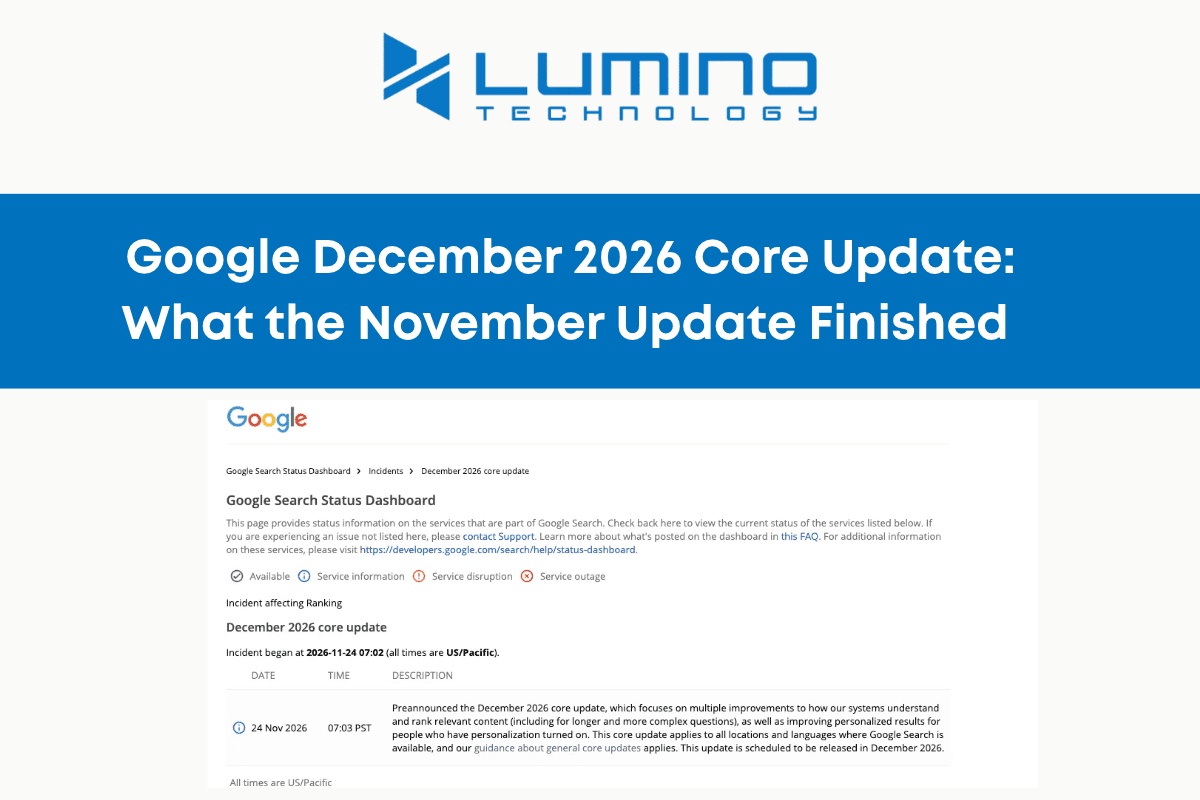
- Google completed the November 2026 core update on November 24 and announced the upcoming December 2026 core update on the same day, without specifying its start date.
- Google recommends waiting at least one week after a core update ends before analyzing data to assess any impact on website rankings.
- To prepare for the December update, website owners should focus on creating high-quality, well-structured content and ensuring their sites are technically sound and user-friendly.
Google finished one core update and announced the next one on the same day. The November 2026 core update completed on November 24 after nearly 14 days, and Google pre-announced a December 2026 core update that same morning. If you run a website, you may be asking one question: should I change anything?

Usually the answer is no. You should measure first, and you should not make panic edits. This guide explains what happened, what Google has said, how to read your data, and what to do before the December rollout starts.
Key Takeaways
The November 2026 core update ran from November 10 to November 24, 2026.
Google pre-announced the December 2026 core update on November 24. It said the update is scheduled for December but gave no exact start date or duration.
Google advises waiting at least one full week after an update ends before analysing your data.
Small ranking drops usually need no drastic action. Large, sustained drops need a page-level review.
The best preparation is helpful, accurate, well-structured content on a fast, easy-to-use site.
What Happened: The 2026 Core Update Timeline
Google has now run three core updates this year, and a fourth is on the way.
Update | Dates | Approx. duration |
|---|---|---|
March 2026 core update | March 27 to April 8 | About 12 days |
May 2026 core update | May 21 to June 2 | About 12 days |
November 2026 core update | November 10 to November 24 | Nearly 14 days |
December 2026 core update | Scheduled for December (pre-announced Nov 24) | Not stated by Google |
Google's own Search Status Dashboard confirms the December pre-announcement.
The gap between the November and December updates is short. That matters. If you see ranking changes in early December, you may not be able to tell which update caused them.
What Google Has Said About the December 2026 Core Update
According to the Search Status Dashboard, Google says the December update will:
Improve how its systems understand and rank relevant content, including longer and more complex questions.
Improve personalised results for users who have personalisation turned on.
Apply in every location and language where Google Search is available.
Google did not name a ranking factor or a type of site. Its normal core update guidance applies. Any article that claims to know exactly what the December update targets is guessing.
Two points are worth noting for your content plan:
Longer, more complex queries. People now ask Google detailed, conversational questions. Pages that answer a full question clearly, with context, are better placed than pages that only repeat a keyword.
Personalisation. Two people can see different results for the same query. A single "rank #1" number matters less than it used to. Look at impressions, clicks and conversions across many queries instead. We explain this shift in our guide on how to measure SEO beyond rankings.
What a Core Update Is (and Is Not)
A core update is a broad change to Google's ranking systems. It is not a penalty, and it does not target one website. Google releases several each year. When a page moves down, it usually means other pages now look more helpful for that query, not that your page did something wrong.

Core updates are also different from spam updates, which go after specific manipulative tactics. If your concern is spammy user-generated content, read our Google UGC spam guide for website owners. For the November rollout itself, see our earlier post, Google November 2026 Core Update: What to Do Right Now.
How to Check Your Core Update Impact in Google Search Console
Google recommends waiting at least one full week after a core update finishes, then comparing the week after it completed with the week before it began.
For the November update, that means:
Baseline week: November 3 to November 9, 2026 (the week before the rollout began on November 10).
Comparison week: November 25 to December 1, 2026 (the first full week after completion).
Open Search Console, then Performance, then Search results, and set the date comparison to those two weeks.
Compare clicks, impressions, average position and CTR.
Check each search type (Web, Images, Video, News) separately to see where the change happened.
Switch to the Pages tab, then the Queries tab, and sort by change in clicks.
A warning about timing. If the December update starts soon, your comparison week may overlap with it. Please note the date the December rollout begins on the Search Status Dashboard and include it in your reports.
Also be careful with seasonality. Late November includes major shopping events for many international e-commerce sites, and Nepali businesses have their festival and holiday cycles. Compare against the same period in past years where possible.
If you need help setting the campaign up, our team can run the analysis as part of an SEO audit.
How to Read the Results: Small Drop or Large Drop?
Google's guidance separates two cases.
A small drop or normal fluctuation. Do not rewrite pages that already perform well. Keep publishing useful content and keep monitoring it.
A large, sustained drop across many pages. Please review the whole site honestly:
Which pages lost the most clicks, and which queries did they lose?
Does the search intent behind those queries still match what the page offers?
Are the pages that now outrank you more complete, more current or easier to use?
Is any section of the site written mainly for search engines instead of for readers?
Google also warns against quick fixes that give users nothing. Deleting content is a last resort, reserved for sections that exist mainly to attract search traffic. Recovery can take months, and in some cases the next core update is the next chance to see improvement.
Do and Don't: Core Update Response
Do | Don't |
|---|---|
Wait one full week after the update ends before analysing data | Change titles and content during the rollout |
Compare clean date ranges in Search Console | Judge success from one day of rank-tracker data |
Review gains as well as losses | Only study the pages that dropped |
Improve thin or outdated pages with real expertise | Mass-delete pages or spin up AI filler |
Ask people outside your team to review your site | Buy links or chase "core update hacks" |
Build Content That Fits Google's EEAT Principles
Google's quality guidance uses the idea of EEAT: Experience, Expertise, Authoritativeness and Trustworthiness. EEAT is not a single ranking score you can switch on. It is a way of asking whether a reader can trust your page. Here is how to apply it page by page.
Experience. Show first-hand work. Include real screenshots, results from your own projects, and lessons from mistakes. Say who did the work and when.
Expertise. Put a named author with a short bio on each article. Our leadership and team page is a good model: readers should be able to see who is behind the advice.
Authoritativeness. Earn mentions because your work is useful. Publish original explanations, case studies and tools. Show your past projects as proof of what you have built.
Trustworthiness. Give clear contact details, accurate claims, honest limitations and current dates. Keep your privacy policy and terms visible. Do not state numbers you cannot support.
An EEAT checklist for each page
A named author and a reviewer, with a bio
A visible published date and "last updated" date
Claims backed by a source, a test or your own data
The main question answered in the first screen
Original examples, images or screenshots
Clear next steps and a way to contact the business
Internal links to related pages that help the reader go deeper
Strengthen Your Site Before December
Content is only part of the picture. Pages must also be easy to find, load and use.
Technical health. Check crawl errors, indexation, mobile usability and page speed. These are the first steps in our SEO service process, which begins with a technical audit.
Site structure and internal links. Link each important page from relevant pages, and use clear anchor text. A page that readers can reach in a few clicks is easier to understand for both people and Google.
Design and usability. Confusing layouts and intrusive pop-ups push readers away. Good UI/UX design supports the same goals as good SEO: clarity and trust.
Build quality. Slow, bloated or broken pages hurt users. If your site's code is the problem, a rebuild through website and mobile app development may be a better fix than another plugin.
Brand consistency. A clear identity helps users recognise and trust you. See our branding service.
Local Businesses in Nepal: What to Watch
If you serve customers in Pokhara, Kathmandu or anywhere else in Nepal, core updates affect you too, because the update applies in every country and language. Local visibility also depends on signals that sit outside your website.
Keep your Google Business Profile complete and accurate. Our guide to the Google Business Profile foundation walks through the setup.
Build useful local content that answers real customer questions, in the language your customers use.
Read our complete guide to digital marketing and SEO in Nepal for local SEO and generative search tactics.
If you are choosing a technology partner, our page on being a software company in Nepal explains how we work.
Prepare for Complex Questions and AI Search
Google's note about longer and more complex questions fits a wider trend. People ask AI-powered search features detailed questions and expect complete answers. To prepare:
Write the direct answer first, then add depth below it.
Cover the follow-up questions a reader is likely to ask.
Use clear headings, short paragraphs, tables and FAQs.
Keep facts current, and update old pages instead of publishing near-duplicates.
For more on this, read How to Rank in AI Search: 2027 Guide and Google AI Mode vs Classic Search in 2027. Our SEO predictions for 2027 explain what we will change and what we will skip for clients. If you are curious how tracking is changing, see Google SERP tracking and AI agents.
Teams that want to reduce repetitive reporting work can also look at AI and automation for dashboards and alerts, or build a tailored tracking tool through custom software development.
Pre-December Action Checklist
Save a Search Console export of your top 100 pages and top 100 queries today
Record the dates of each site change you make (content, design, technical)
Review the November comparison (Nov 3 to 9 vs Nov 25 to Dec 1)
Update outdated posts on your most important topics
Add author bios, sources and "last updated" dates to key pages
Fix technical issues: slow pages, broken links, mobile problems
Strengthen internal links to your best service and guide pages
Set up alerts so you know when the December rollout starts
Pause large redesigns or migrations during the rollout, if you can
Frequently Asked Questions
When is the Google December 2026 core update?
Google says it is scheduled for December 2026. It pre-announced the update on November 24 but has not given a start date or an expected length. Check the Search Status Dashboard for the official start.
Is the November 2026 core update finished?
Yes. Google confirmed that the November 2026 core update completed on November 24, 2026, after rolling out from November 10.
Should I change my website because of the December update?
Not yet. Measure first. If your data shows a small change, keep doing what works. If you see a large, sustained loss after the rollout ends, run a page-level review before you change anything.
How long should I wait before checking rankings after a core update?
Google recommends waiting at least one full week after the rollout ends, then comparing that week with the week before the update began.
Can I recover after a core update drop?
Often yes, but it takes time. Improvements to content quality and user experience can take months to be reflected. Avoid shortcuts, because they rarely help real readers.
Will the update affect my website in Nepal?
Yes, it applies in every location and language where Google Search is available. Local businesses should also keep their Google Business Profile and local content up to date.
Conclusion
The November 2026 core update is complete, and the December 2026 core update is coming. You cannot control the timing, but you can control how well you are prepared: measure with clean data, avoid panic changes, and keep improving pages for the people who read them.
If you want an expert second opinion on your traffic, request a free SEO audit or contact the Lumino team. You can also browse more guides on the Lumino Technology blog, learn the skills yourself through our training and consultation programs, or return to the Lumino Technology homepage.